
People often face complex problems that require them to identify hidden relationships. Pattern recognition in puzzles is essential to solving these problems effectively. This ability involves identifying repeating structures, sequences, or motifs in a set of pieces, allowing solvers to predict outcomes and make informed decisions. Developing this skill improves problem solving in a variety of fields and accelerates understanding of everyday situations.
Beginners can begin with simple, everyday exercises, such as observing symmetry in nature or analyzing patterns in tiles and art, to develop basic pattern recognition skills. Many intellectual activities, from jigsaw puzzles to logic games, rely on this knowledge for effective solutions.
Without this knowledge, solvers may spend too much time on trial and error, highlighting the importance of structured practice. Here’s a framework for learning basic pattern recognition techniques, chess-inspired strategies, targeted practice exercises, and practical applications.

Defining Pattern Recognition
Pattern recognition serves as the core mechanism for understanding puzzles. It enables individuals to detect similarities and predict outcomes based on observed data. In puzzles, this means linking shapes, numbers, or positions to form a complete picture. Cognitive scientists define it as the brain’s process of categorizing information into familiar groups.
Practical advice involves daily exercises, like examining leaf arrangements or tile designs to spot natural repeats. For beginners exploring puzzle strategies, resources such as Unlocking Cabbage Patch: A Beginner’s Guide provide step-by-step instructions to build foundational pattern recognition skills before moving on to more complex challenges.
“This is the essential element of human cognition: the ability to process vast amounts of information and distill it into a simple pattern or rule.”— Garry Kasparov, 13th World Chess Champion and Author

Core Elements and Examples
Studies highlight how the brain processes visual and logical cues. For instance, in Sudoku, players spot numerical sequences to fill grids. A 2022 ACM paper explains that puzzles like these build logical sequences through repeated exposure. Experts from IEEE note that even apictorial jigsaw puzzles rely on shape matching algorithms, mirroring human methods. Pattern recognition in puzzles often involves breaking down complex images into basic components. This approach reduces errors and speeds up completion. To further optimize your solving time, consider adopting specific speed-running strategy puzzles techniques that focus on minimizing wasted moves. Tips from speed puzzlers suggest focusing on color gradients first for quicker grouping.
Real cases show its impact. Chess players use it to anticipate moves, as per Chess.com insights. In jigsaw assembly, recognizing piece shapes cuts time by half, according to speed puzzling guides. Data from educational platforms indicate that children exposed to these tasks score 15 percent higher in math tests. These examples confirm its value in building analytical skills. Another application appears in art, where artists identify motifs to create balanced compositions.
Steps to Identify Basic Patterns
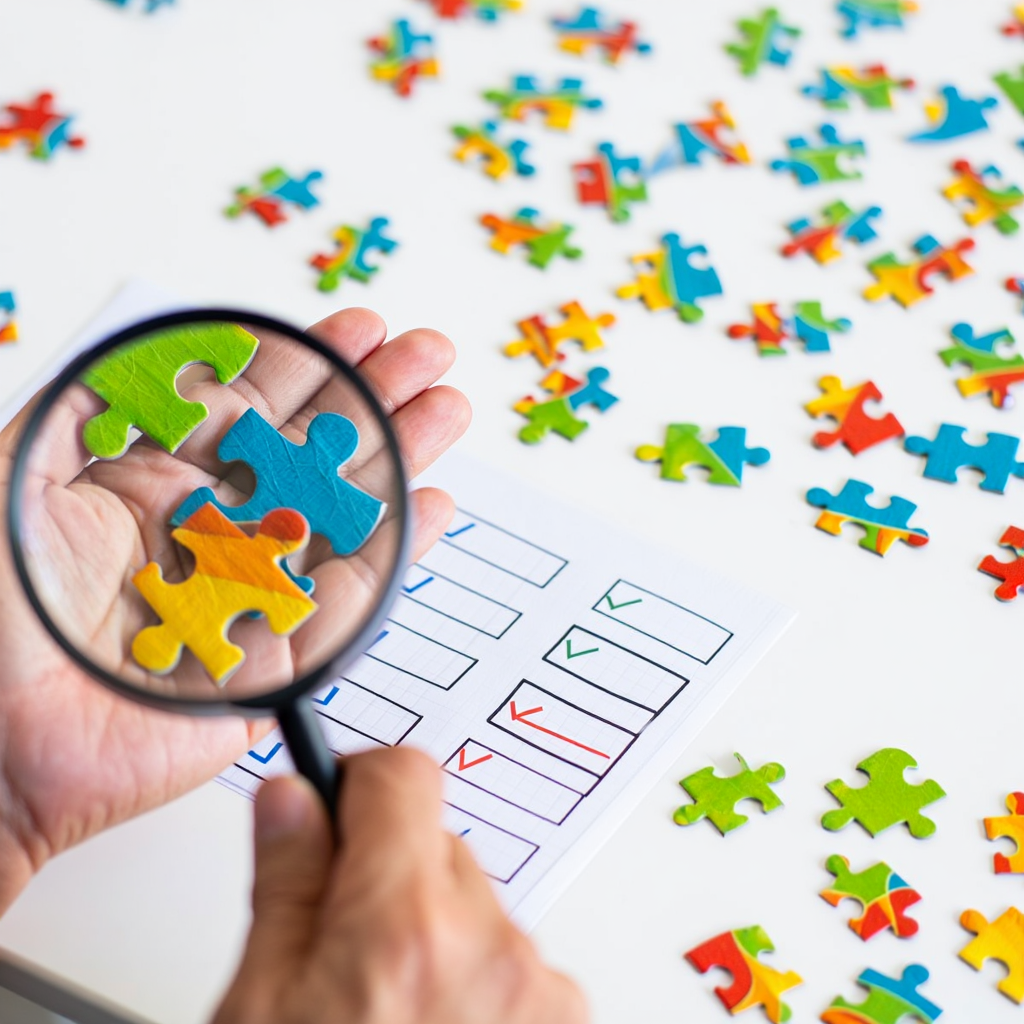
Start by scanning the entire puzzle layout. Note colors, edges, or numbers that repeat. Group similar items together for easier comparison. Test connections by placing potential matches side by side. A practical tip is to use a magnifying glass for fine details in intricate designs.
Next, eliminate mismatches quickly. Beginners often fall into traps by forcing connections; reviewing a guide on mistakes to avoid in Sprouts or similar logic games can help you identify these pitfalls early. Use a grid or chart to track progress Rotate pieces if needed to reveal hidden alignments. Practice on simple versions before advancing. Experts recommend setting timers to build speed under pressure.
For numerical types, list possible sequences. Cross out impossibles based on rules. Verify each step against the whole. This method ensures steady advancement. Incorporate breaks to refresh focus and avoid fatigue.
In visual puzzles, focus on textures first. Then move to shapes. Combine them logically. Repeat until the image emerges. Try working in small sections to maintain momentum.
These instructions help beginners grasp fundamentals. They build confidence through structured practice. Pattern recognition in puzzles becomes intuitive with consistent application.
Pattern recognition in puzzles forms the bedrock for advanced skills. It transforms random elements into coherent solutions. Mastering this opens doors to more intricate challenges. Practical tips like studying architecture patterns can enhance spatial awareness.
The 3-Step Pattern Deconstruction Method
To actively build your mental library of patterns, don’t just solve puzzles—analyze them. Use this three-step loop whenever you encounter a new mechanic:
- Isolate the Trigger: What specific visual cue (e.g., two parallel lines, a cluster of three numbers) immediately preceded the solution?
- Name the Pattern: Give it a memorable name (e.g., “The T-Shape,” “The Ghost Pair”). Naming aids memory retention significantly better than abstract observation.
- Verify Across Contexts: Try to find the same formation in a different part of the puzzle or a new game to confirm it is a repeatable rule, not a one-off coincidence.
Techniques from Chess
Chess provides powerful tools for spotting motifs in games. Players rely on memorized positions to outmaneuver opponents. This mirrors pattern solving in broader contexts. Grandmasters attribute success to quick identification of familiar setups. Practical advice includes reviewing famous games to internalize common setups.
Common Types of Patterns in Puzzles
Pattern recognition isn’t just about chess forks or Sudoku candidates — it’s a universal skill that appears in many forms. Here’s a clear breakdown of the most frequent pattern families you’ll encounter across different puzzles:
- Spatial Transformations
- Rotation (90°, 180°, or 270° clockwise/counterclockwise)
- Reflection (horizontal, vertical, or diagonal mirror)
- Translation / sliding (elements move in a fixed direction)
- Quantitative Progressions
- Addition / subtraction of elements (one more dot/line/shape each step)
- Multiplication / division (doubling, halving sizes or counts)
- Arithmetic or geometric sequences in number of objects
- Logical & Set Operations
- Union (combining shapes)
- Intersection (common parts only)
- XOR / symmetric difference (what’s unique to each)
- Overlay / layering (elements placed on top with rules)
- Attribute Changes
- Color cycling or gradients
- Size scaling
- Orientation / flipping
- Filling / emptying (shading patterns)
- Positional & Relational
- Inside/outside relationships
- Clockwise / counterclockwise movement
- Symmetry (rotational, bilateral, point)
- Balance or centering
Mastering these categories gives you a mental checklist: when you see a 3×3 or 4×4 grid, quickly scan for rotation → progression → addition → symmetry. This systematic approach cuts solving time dramatically.
Key Chess Patterns and Their Puzzle Parallels
Tactical motifs like forks and pins appear in many puzzles. A Chess.com article lists 10 essential ones, including knight forks on weak squares. These resemble Sudoku’s candidate eliminations. Research from Lichess blogs debates if chess leans more on patterns or pure calculation. Pattern recognition in puzzles draws from this, aiding in logic grids. Tips for application involve scanning boards for vulnerable pieces first.
Experts cite studies where players solve positions faster after training. One from TheChessWorld shows accuracy rises with exposure to thousands of exercises. Chess-like strategies involve anticipating sequences, much like jigsaw assembly.
A 2024 Quora discussion links chess to improved recognition speeds. These parallels enhance overall cognitive performance. Advanced puzzle techniques benefit from visualizing multiple outcomes.
| Chess Pattern | Puzzle Equivalent | Benefit | Practical Tip |
|---|---|---|---|
| Fork | Multiple eliminations in Sudoku | Attacks two targets at once | Practice on weak squares daily |
| Pin | Locked candidates in logic games | Restricts options | Identify restrictions early |
| Discovered Attack | Hidden pairs in crosswords | Reveals new opportunities | Look for covering pieces |
| Skewer | Chain reactions in mazes | Forces sequential moves | Anticipate opponent responses |
This table compares elements for clearer understanding. It includes tips for immediate use.
Applying Chess Methods Step by Step
Start with basic openings by studying common setups, such as the French Defense. Pay attention to repeating themes in positions and consider how these patterns can translate to puzzle grids. Diagramming moves on paper can help reinforce retention and deepen understanding.
Next, focus on middlegame tactics by solving puzzles centered on a single motif, like bishops on diagonals. Track your progress over time to monitor improvements in speed and accuracy, and use apps for daily practice. Fully calculating variations helps avoid mistakes and strengthens analytical thinking.
For endgames, memorize key king and pawn patterns and practice predicting outcomes in puzzles by simulating similar scenarios mentally. Adjust your approach based on results, reviewing errors to refine strategies.
Integrate chess-like strategies into your daily routine by analyzing past games for recurring motifs and adapting these insights to non-chess puzzles. Themed sessions targeting specific weaknesses can build versatility and sharpen recognition skills. Through consistent practice, these methods cultivate advanced puzzle-solving abilities and foster deeper insight into complex challenges.
Practice Drills
Drills sharpen the mind for detecting regularities. Consistent sessions lead to automatic responses. This applies directly to pattern recognition in puzzles. Trainers recommend tailored exercises for steady growth. Practical tips emphasize variety to keep engagement high.
Effective Drill Types with Evidence
Tactical puzzles from platforms like Chess.com boost speed. A Reddit thread suggests custom sets for targeted practice. HappyNeuron Pro offers games like “Chunking” for visual skills. Studies show solving 100 puzzles weekly improves accuracy by 25 percent. Pattern recognition in puzzles strengthens through such routines.
Pattern solving drills include Sudoku variants. Experts from Codingame emphasize programming puzzles for logic. Chess forums advocate repeating motifs for retention. These build neural pathways, per cognitive research. Tips include combining with physical activities for better focus.
- Timed sessions: Set limits to mimic pressure.
- Themed sets: Focus on shapes or numbers.
- Progressive difficulty: Start easy, increase complexity.
- Review errors: Analyze misses for patterns.
- Nature observation: Spot repeats in surroundings.
This list outlines proven approaches. It adds outdoor elements for freshness.
Detailed Training Instructions
Select a drill type, like figure series. View sequences and predict next. Time each attempt. Note common errors. A practical tip is to journal insights for long-term tracking. Here are some tips from experts:
- For chess-like strategies, use puzzle apps. Solve 20 daily tactics. Categorize by motif. Repeat weak areas. Pair with friends for discussion.
- In jigsaw drills, sort pieces by edge type. Assemble borders first. Then fill interiors by color. Track completion times. Experiment with different puzzle sizes.
- For numerical patterns, practice Sudoku. Fill easy grids quickly. Advance to experts. Use pencil marks for candidates. Challenge yourself with variants like Killer Sudoku.
- For abstract visual patterns, try Raven’s Progressive Matrices style drills. Use 3×3 grids with shapes. Identify rules like rotation, increasing elements, or additions. Predict the missing piece from options. Start with free online sets for quick practice.
- Practice simple progression drills daily. Example: Row 1 shows 1 dot → 2 dots → 3 dots horizontally. Row 2: 1 square → 2 squares diagonally → 3 squares diagonally. Row 3: 1 triangle → 2 triangles vertically → ? (Answer: 3 triangles vertically). Rule: number increases by 1 per column; arrangement style fixed per row. Do 10 similar ones to build intuition fast.
- Incorporate variety weekly. Mix visual and logical types. This prevents plateaus. Try group sessions for collaborative learning.
- Advanced puzzle techniques require dedication. They yield measurable gains. Pattern solving evolves with persistence.
- Drills solidify skills over time. They prepare for real challenges. Commitment leads to mastery. Chess-like strategies integrate seamlessly here.
Real-World Applications
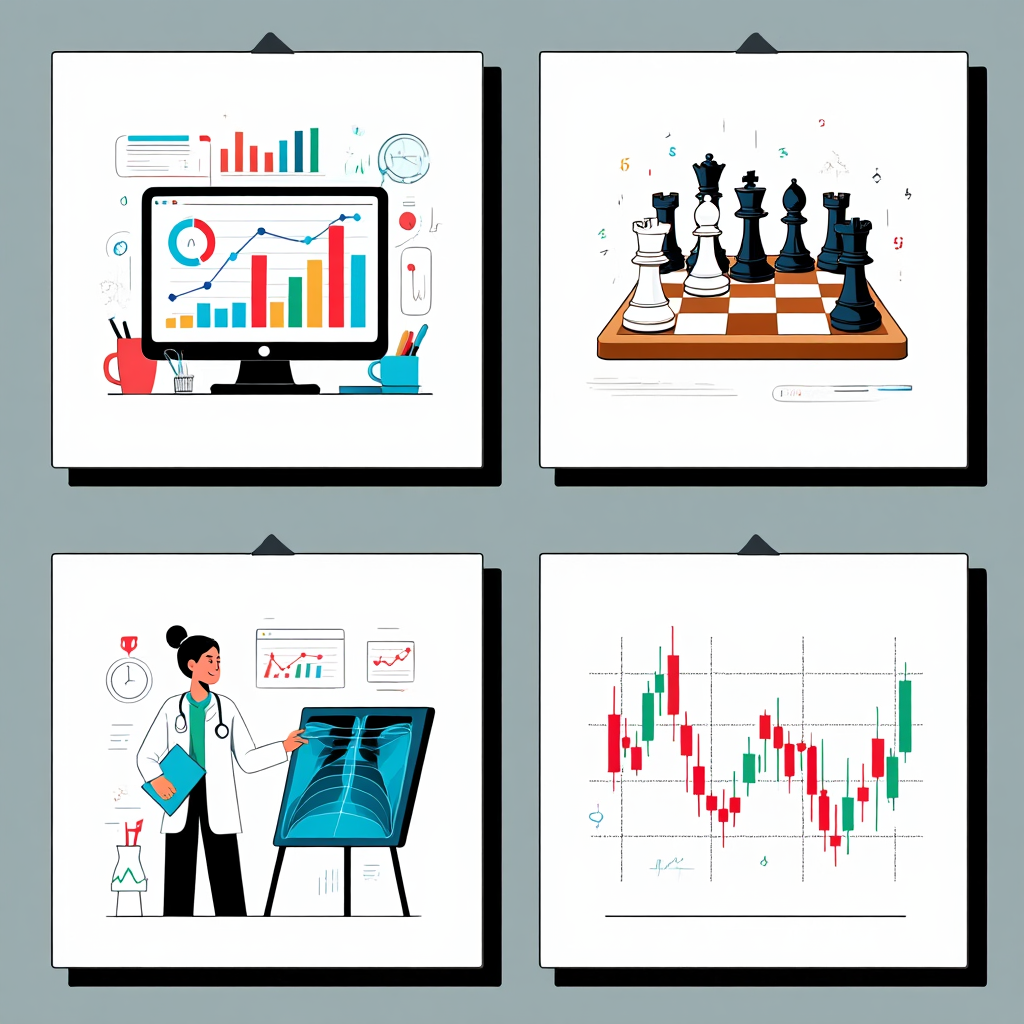
Skills from puzzles extend beyond games. They solve practical problems in diverse areas. Pattern recognition in puzzles trains the brain for everyday use. Professionals apply it in fields like medicine and finance. Practical tips involve adapting to work tasks, like trend spotting in reports.
Practical Uses and Case Studies
Medical diagnosis relies on spotting symptoms. A Number Analytics blog cites pattern use in forecasting diseases. Financial experts predict trends via data sequences. Chess patterns aid in strategic planning, per gschess.com. In tech, algorithms mimic human recognition for image processing. Origami design uses folding sequences for complex structures.
Education benefits children through apps like SmartTales. Computational thinking uses it for problem decomposition. A Reddit example shows bird identification via sound patterns. These cases demonstrate broad impact. AI applications now solve word puzzles with high accuracy.
Pattern solving appears in quality control. Factories detect defects through repeats. Chess-like strategies help in negotiations by anticipating moves. Constraint problems in data science mirror puzzle logic.
Implementing in Daily Life
Begin by observing your daily routines to spot inefficiencies and recurring issues. Once you recognize these patterns, develop practical solutions to address them, and use habit-tracking apps to monitor progress and reinforce improvements. In the workplace, analyze data sets for trends and recurring behaviors, and leverage visualization tools like spreadsheets to gain deeper insights. Collaborate with colleagues to gather diverse perspectives and refine your strategies.
For learning and skill development, break complex concepts into logical sequences and connect them systematically. Incorporate puzzle-solving exercises into study breaks to sharpen analytical abilities. You can also apply these techniques to hobbies and personal projects—for example, planning garden layouts, designing artwork, or optimizing home organization—by identifying repeating motifs and sequences.
By consistently practicing these methods, pattern recognition skills transition seamlessly from puzzles into everyday problem-solving. Applying these strategies enhances creativity, supports innovation, and turns everyday routines and hobbies into opportunities for growth. Starting small and building gradually ensures sustainable progress and lasting benefits.
FAQ
Questions often arise about these methods. Answers clarify common concerns. They flow from the discussed concepts.
How does pattern recognition in puzzles differ from general observation? It focuses on structured repeats, unlike casual looking. Puzzles demand precision. This builds deeper analysis.
Why incorporate chess-like strategies into non-chess activities? They teach anticipation and planning. Patterns transfer to business or sports. Studies show improved decision-making.
What makes practice drills effective for pattern solving? Repetition strengthens memory. Variety prevents boredom. Data indicates consistent gains.
How can beginners start with advanced puzzle techniques? Begin simple. Build gradually. Use guides for structure. Include nature walks for inspiration.
Why apply these to real-world problems? They solve complexities efficiently. Examples include tech and health. Benefits include faster resolutions.
What better suits visual learners: drills or chess methods? Both work, but chess offers dynamic examples. Combine for best results. Tips like drawing diagrams help.
For example, you can watch the video. The lesson will be interesting for beginners who are just starting to learn Sudoku. It explains how to recognize and use the “completed segment” pattern for more efficient puzzle solving. The author defines a segment, shows how to recognize it, and demonstrates how to use this pattern to place numbers on the grid. The video includes examples and tips on using the “completed segment” in various situations.
Advanced techniques in recognition transform how people approach challenges. Key ideas include defining core skills, drawing from chess, drilling consistently, and applying broadly. Pattern recognition in puzzles underpins all this. It fosters growth in multiple areas. Expanded insights show its role in emerging fields like AI.
Readers should start practicing today. Pick a puzzle or drill. Track progress. The rewards extend far. Incorporate tips for quicker results.
Sources
- Templates in chess memory: A mechanism for recalling several boards. (1996, Carnegie Mellon University & University of Nottingham). Templates in chess memory
- Garry Kasparov, 2017. Deep Thinking: Where Machine Intelligence Ends and Human Creativity Begins.