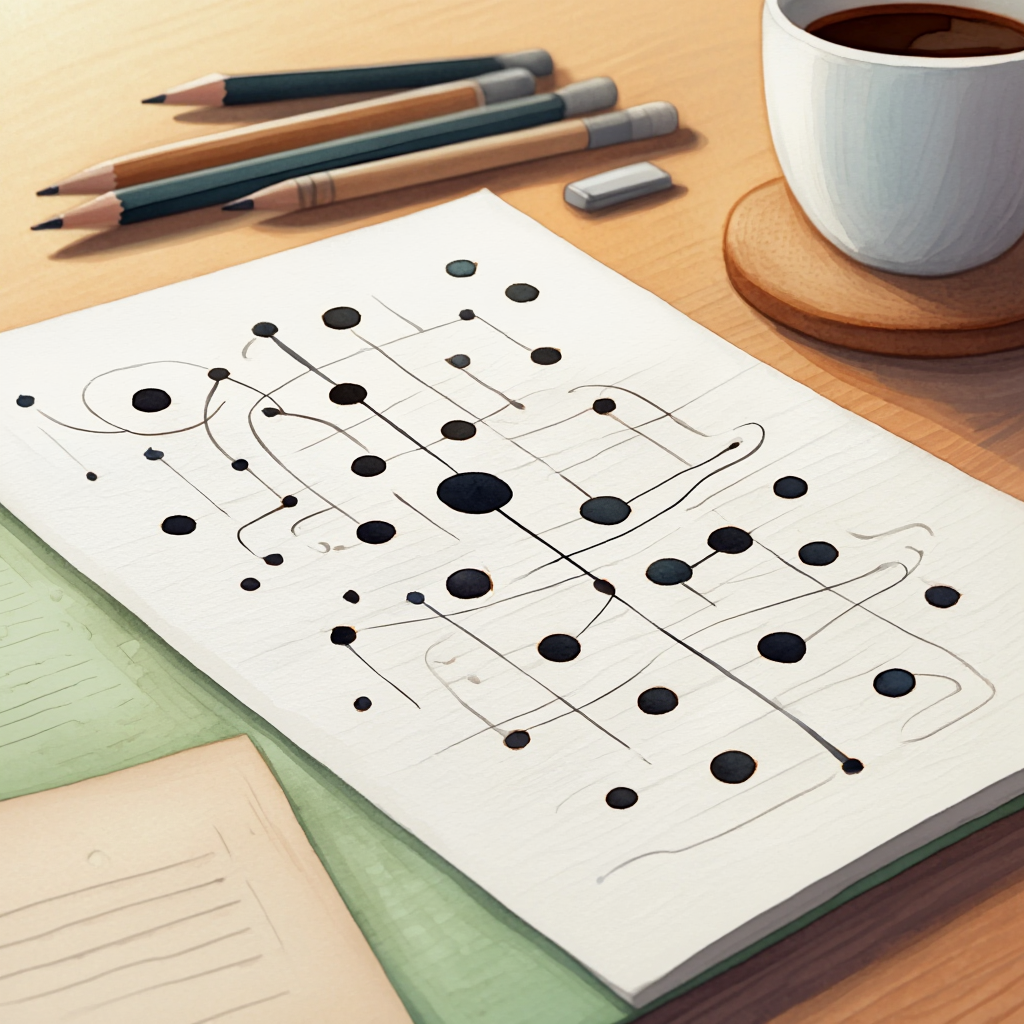
Imagine a game that’s as simple as doodling on a napkin, but as addictive as a game of chess. Sprouts is exactly that: a puzzle you can solve with just pencil and paper that turns a few dots and lines into a battle of wits. Whether you’re a math buff or just looking for a fun way to pass the time, this game will hook you with its deceptive simplicity and strategic depth. But what exactly is Sprouts? It’s a two-player game where players connect dots with lines, adding new dots along the way, following strict rules that make every move count.
Invented in the 1960s, it’s also known as the Brussels Sprouts game for its intricate, vegetable-like patterns. Let’s find out its origins, how to play Sprouts, why it captivates players so much, and how Sprouts’ early years shaped its enduring popularity. Ready to dive into this addictive game? Let’s dive into its origins, rules, and charm.

The Origin of Sprouts
The sprouts game was born from mathematical curiosity, blending simplicity with complex strategy.
The Birth of a Mathematical Gem
The sprouts game emerged in the 1960s at Cambridge University, created by mathematicians John Conway and Michael Paterson. Both were fascinated by game theory, the study of strategic decision-making. Conway, known for his love of elegant puzzles, wanted a game that was easy to learn but rich in possibilities. The result was early sprouts—a game that used just dots and lines to challenge even the sharpest minds. According to Conway, the game’s beauty lies in its ability to “hide profound mathematical ideas in a simple setup.” This origin story sets the stage for why sprout games became a favorite among thinkers and casual players alike.
Examples of Early Popularity
In its early sprouts days, the game spread quickly among Cambridge students, who played it during coffee breaks and lectures. By 1967, Martin Gardner featured it in his Scientific American column, calling it “a game of surprising depth.” This exposure turned sprout games into a global phenomenon, with players sketching boards in classrooms and pubs. For example, a 1970s math club at MIT reportedly held sprouts tournaments, where players competed to outsmart each other with clever moves. These early examples show how the game’s simplicity fueled its rapid rise.
The sprouts game began as a mathematical experiment but quickly became a cultural hit. Its origins highlight how a simple idea can captivate diverse audiences, setting the foundation for its enduring popularity.

How the Game Works
The sprouts game is easy to learn but requires strategic thinking to master, making it a unique blend of art and logic.
Understanding the Rules
To play sprouts, all you need is paper, a pen, and a friend. Before you begin, read the official rules. Start by drawing a few dots (typically three) on a blank sheet. Players take turns drawing a line between two dots or looping a line back to the same dot, then placing a new dot on that line. The catch? Lines can’t cross, and each dot can have at most three lines connected to it. The game ends when no legal moves remain, and in standard play, the last player to move wins. Here’s a quick breakdown of the rules:
- Connect dots: Draw a line between two dots or loop back to one dot.
- Add a new dot: Place a dot on the line you just drew.
- No crossing: Lines must not intersect or touch existing lines.
- Three-line limit: A dot with three lines is “dead” and can’t be used as an endpoint.
- Winning: In standard play, the last player to move wins; in misère play, the last player loses.
These rules make sprout games both accessible and challenging, as every move reshapes the game board.
Examples of Gameplay
Let’s walk through a simple game with three dots. Player 1 draws a line from Dot A to Dot B, placing a new dot (Dot D) on the line. Now, Player 2 connects Dot D to Dot C, adding Dot E. As the game progresses, players must avoid boxing themselves in or leaving easy moves for their opponent. In a real-life example, a 2015 math workshop saw kids playing a two-dot game, finishing in five moves, while a six-dot game among adults lasted over 20 moves, showcasing how complexity scales with more dots.
The sprouts game thrives on straightforward rules that lead to intricate strategies. Whether you’re sketching quick rounds or diving into longer battles, understanding the mechanics is the first step to mastering this game.
Use this move-tracking table to log your games and review strategies afterward—it turns each match into a learning opportunity.
| Move Number | Player | From Dot | To Dot | New Dot Placed | Notes on Strategy |
|---|---|---|---|---|---|
| 1 | Player 1 | A | B | D | Blocked center |
| … | … | … | … | … | … |

Why It’s More Than Just Dots and Lines
The sprouts game transcends its simple setup, offering a mix of strategy, creativity, and mathematical depth that keeps players engaged.
The Strategic Heart of Sprouts
At its core, play sprouts is about outsmarting your opponent. Each line you draw can block your rival’s moves or open new paths for yourself. The game’s liberties—the number of lines a dot can still accept (up to three)—are critical. For instance, connecting a dot with two liberties to one with one liberty can limit your opponent’s options.
A 1990 study by David Applegate and others analyzed sprout games and found that games with n starting dots typically last between 2n and 3n-1 moves, proving the game’s depth grows with its setup. Strategic planning, much like in chess, is what makes the brussel sprouts game so compelling.
Key Terms in Sprouts
| Term | Definition | Why It Matters |
| Liberties | Number of lines a dot can still accept. | Tracks available moves for each dot. |
| Survivors | Dots with fewer than three lines at the end. | Determines the winner in standard play. |
| Pharisees | Dead dots not connected to survivors. | Influences game length and strategy. |
| Regions | Areas enclosed by lines. | Restricts moves and shapes the board. |
| Clusters | Groups of connected dots. | Defines the board’s structure and options. |
This table illustrates the mathematical underpinnings that make sprout games a puzzle lover’s dream. To illustrate, consider a common opening: If Player 1 connects two starting dots with a curve that blocks easy access, Player 2 might respond by looping back to create a cluster, forcing the opponent to defend liberties early. This tactic can extend the game and limit options, turning a simple board into a complex web. As you delve deeper into strategy, familiarizing yourself with these key terms will help you anticipate your opponent’s moves more effectively.
Creative Freedom in Play
Unlike rigid games like tic-tac-toe, the sprouts game allows players to draw lines in any shape—curved, jagged, or swirling—as long as they don’t cross. This freedom lets players express creativity while strategizing. For example, during a 2018 math conference, participants created boards with spiral patterns, turning games into visual art. This blend of structure and imagination sets sprout games apart, making every board a unique creation.
A Game of Mind and Art
The sprouts game is more than dots and lines—it’s a strategic and creative playground. Its mix of logic and artistic freedom ensures players keep coming back to test their skills and imagination.
Why Sprouts Keeps Drawing Players
The sprouts game remains popular due to its accessibility, scalability, and vibrant community, appealing to players of all ages and skill levels.
Accessibility for All
One of the game’s biggest strengths is its simplicity. Sprout games require no special equipment—just a pen and paper. This makes it ideal for classrooms, coffee shops, or family gatherings. A 2011 analysis by NRICH (University of Cambridge) highlighted Sprouts’ accessibility, noting its quick learning curve and mathematical depth for all ages. (2011, University of Cambridge). Kids enjoy the drawing aspect, while adults appreciate the mental workout, making early sprouts a timeless hit.
Scalability and Variety
The brussel sprouts game adapts to different skill levels. Start with two dots for a quick match that might last five moves, or try six dots for a game that could stretch to 17 moves or more. Here’s what makes it versatile:
- Quick games: Two or three dots for fast rounds.
- Complex challenges: More dots increase strategic depth.
- Unique boards: No two games look alike.
- Mental exercise: Forces players to plan ahead.
- Social fun: Perfect for friendly competitions.
For instance, a 2022 online sprouts tournament saw players experiment with 10-dot setups, creating sprawling, complex boards that tested their foresight.
A Thriving Community
The sprouts game has fostered a dedicated community. The World Game of Sprouts Association hosts online forums where players share strategies and analyze famous games. A notable example is a 2019 thread where players debated optimal moves for a five-dot game, uncovering new patterns. Digital apps have also brought sprout games to phones, though many purists prefer the tactile joy of pencil and paper. The game nickname remains a quirky nod to its visual style, keeping the community’s vibe playful. To make your first game even easier, sketch a quick starting board with three dots spaced evenly—this setup balances speed and strategy, allowing you to experiment without overwhelming complexity.
FAQ: Common Questions About the Sprouts Game
- How do you start a sprouts game?
Draw two or more dots on paper. Take turns connecting dots with a line, adding a new dot on each line. Follow the rules: no crossing lines, and each dot can have up to three lines. - Why is it called the brussel sprouts game?
The playing fields often resemble intricate, vegetable-like shapes, which has earned the early players the playful nickname “the Brussels sprouts game“. - What’s better: standard or misère play?
Standard play (last mover wins) is more intuitive for beginners, while misère play (last mover loses) adds a strategic twist for experienced players. Try both to see which you prefer! - How long does a sprouts game last?
Games with 2–3 dots can end in 5–8 moves, while 6+ dots may take 15–20 moves, depending on strategy. A 1990 study estimated games last between 2n and 3n-1 moves for n dots.
From its early sprouts to today’s digital versions, the sprouts game captivates with its accessibility and depth. Its ability to scale and its passionate community ensure it remains a beloved pastime.
In the video, you can visually see the process of playing the board game “Spots”. The host explains the rules of the game and demonstrates how to play it. Two people participate in the game, who need a sheet of paper and three dots.
Sprouts Puzzle Collection: Levels 1-5 (Free PDF Download for Beginners)
Master Sprouts basics with these free printable Sprouts worksheets! Download our Sprouts puzzles PDF featuring beginner exercises levels 1-5. Perfect for kids, classrooms, and math enthusiasts. Each level builds skills: recognize legal moves, avoid mistakes, and find the best move in simple positions. Print, play, and learn graph theory through fun!

Quick Start Guide
- Draw the position on paper.
- Rules reminder: Connect two spots with a curve (no crossing lines), add a new spot on the curve. Max 3 lines per spot.
- Best move: The one that leads to your win with perfect play (normal play: last move wins).
- Levels: 1 (super easy) → 5 (intro to strategy).
Conclusion
The sprouts game is a rare gem—simple enough for anyone to pick up, yet deep enough to challenge the sharpest minds. From its early sprouts in the 1960s to its modern digital iterations, it blends strategy, math, and creativity into a unique experience. Whether you’re sketching a quick round with a friend or diving into a complex board, play sprouts offers endless fun. Grab a pen, draw a few dots, and give the brussel sprouts game a try. You might just find yourself hooked on this clever puzzle.
Start with three dots and challenge a friend to a sprouts game today. Share your boards online or join the World Game of Sprouts Association to connect with other fans!
Sources
- 1991, Carnegie Mellon University. Computer Analysis of Sprouts.
- 2011, University of Cambridge. Sprouts Explained.
- Conway, 2011, NRICH (University of Cambridge). Sprouts Explained.
- Moves bounds (2n to 3n-1). Sprouts (game) – Wikipedia.